




Supply Chain Management Deep Dive: A Complete Guide to Risk, Compliance, and Sustainability
Behind every product you touch, from your morning coffee to your laptop, lies a supply chain so complex that a single failure or disruption can ripple across continents. Today, managing that invisible network of supply chain processes has become one of the most critical challenges for modern businesses, the Supply Chain Management. Supply chains have undergone a profound transformation. What once resembled a straightforward, operation-focused function, moving goods from suppliers to warehouses to customers, has evolved into a complex global ecosystem where the smooth flow of data is just as important is moving of the products.
In the past, the main focus of organizations was on logistics: transportation of good and products, warehousing, and delivery. But as businesses expanded across borders, as outsourcing increased, and as markets became more volatile and complex, pure business logistics management alone could no longer capture the full picture of the processes. As the supply chain network grew more complex, simple business logistics could not cover all the requirements of this complex system. This transformation gave rise to Supply Chain Management (SCM), a strategic discipline that integrates planning, procurement, production, distribution, risk management, compliance, and supplier relationship management into one coordinated system.
While logistics is about moving goods, Supply Chain Management (SCM) is about managing value, relationships, information, and risk in addition to moving goods. It connects every function involved from producing to delivering a product or service, from supplying raw materials all the way to improving customer satisfaction, and ensures they work together efficiently and responsibly.
Companies operate in an environment defined by global interdependencies, rapid technological change, and rising expectations from regulators, investors, and customers. That is why today, SCM is not just important, it is mission-critical.
Supply chains must now be:
- Global: spanning multiple countries, cultures, and regulatory frameworks
- Compliant: aligning with complex company-specific standards such as quality and security guidelines and legal requirements like Lieferkettensorgfaltspflichtengesetz (LkSG, German Supply Chain Due Diligence Act), Corporate Sustainability Due Diligence Directive (CSDDD, an EU-wide directive that extends the idea of the German LkSG to all EU member states, creating a harmonized legal framework for corporate due diligence) and Corporate Sustainability Reporting Directive (CSRD, an EU directive that fundamentally changes how companies must report on sustainability, ESG, and non-financial information)
- Sustainable: reducing emissions, proving ethical sourcing, managing sustainable supply chains, and handling ESG (Environmental, Social, and Governance, a framework used to evaluate a company's sustainability and ethical impact by assessing its performance in these areas) data
- Transparent: able to trace materials, verify supplier claims, and provide audit-ready documentation on demand with enhanced supply chain visibility
This new complexity raises the stakes dramatically. A single missing certificate, delayed shipment, or unverified supplier can trigger operational disruptions, financial losses, or even legal penalties. Conversely, companies that master their supply chains gain significant advantages: stronger business continuity, faster time-to-market, lower risk exposure, and deeper trust among customers and partners.
Yet many organizations still rely on traditional SCM models: manual document tracking, disconnected systems, spreadsheets, emails, and limited visibility across their supplier network. These legacy approaches were never designed for today’s global and highly regulated reality.
This is why modern Supply Chain Management requires more than just coordination. It demands digital transformation, real-time insights, and automated compliance processes. The shift from reactive to proactive, from manual to digital, from isolated operations to connected networks is not optional anymore, it is essential for a successful business.
In the following sections, we explore what defines effective Supply Chain Management (SCM) today. We will also take a look at the technologies that are driving its evolution, and how companies can build resilient, transparent, and compliant supply chains that can meet the demands of a rapidly changing world.
What Is Supply Chain Management?
Behind the scenes of every successful company is an architecture of suppliers, manufacturers, logistics partners, and customers, all coordinated through the Supply Chain. Supply Chain Management (SCM) is the strategic coordination of every activity involved in creating and delivering a product or service, from supplying raw materials to placing the final product in a customer’s hands. It integrates planning, procurement, production, logistics, distribution, and customer service into one unified system. This system must be designed to maximize efficiency, reduce risk, and ensure both quality and compliance across the entire value chain. The key functions of a supply chain include product development, marketing, operations, distribution, finance, and customer service.
At its core, Supply Chain Management (SCM) ensures that the right products and services reach the right place at the right time, in the right condition and quality, and at the lowest possible cost, while meeting increasingly complex regulatory and sustainability requirements.
5 Key Functional Elements of SCM
To better understand how effective supply chain management (SCM) creates net value and builds competitive infrastructure, it helps to break it into five fundamental elements. These elements work together to reduce costs, improve visibility, and ensure compliance throughout the entire supply chain.
1. Procurement
Procurement forms the foundation of the supply chain by determining where, how, and from whom materials and services are sourced. This function involves selecting, evaluating, and managing suppliers through effective supplier relationship management, ensuring supplier compliance with quality, ethical, and regulatory standards, and promoting social responsibility in sourcing practices. By securing reliable and compliant suppliers, procurement helps reduce costs and risks while creating net value for the business.
2. Production
Production is where value is created by converting inputs into market-ready products through manufacturing or processing. This includes mass production techniques like scheduling, capacity planning, quality control, and operations management. Ensuring compliance with industry standards and maintaining consistent quality are critical to sustaining competitive advantage and minimizing waste. Efficient production processes contribute to reducing costs and improving overall supply chain resilience.
3. Logistics
Logistics connects all supply chain stages by managing the movement and storage of goods, including transportation, warehousing, and inventory management. Improving visibility across logistics operations enables companies to monitor shipments in real time, optimize routes, and prevent delays. This transparency supports compliance with regulatory requirements and helps reduce costs associated with inefficiencies or disruptions.
4. Distribution
Distribution focuses on delivering products to the right destination at the right time. It ensures that goods move efficiently from distribution centers to retailers, wholesalers, or directly to customers, achieving on-time and in-full (OTIF) delivery. A well-managed distribution network forms a competitive infrastructure that supports customer satisfaction and responsiveness in dynamic markets.
5. Customer Service
Customer service closes the supply chain loop by managing post-sale interactions, including handling returns, troubleshooting issues, and providing ongoing support. Emphasizing social responsibility, this function ensures that customer satisfaction is maintained and that returned products are processed sustainably. Effective customer service reinforces brand trust and completes the cycle of compliance and accountability throughout the supply chain.
Together, these five functional elements enable companies to balance efficiency, responsiveness, compliance, and social responsibility across global supply chain operations.

5 Key Participants of a Supply Chain Network
A supply chain is not just a sequence of actions; it is a complex network of interconnected partners. The coordinated activities of these partners ensure the smooth flow of goods, information, and compliance across the entire supply chain.
The core components of a Supply Chain Network typically include:
- Supplier: Provides raw materials, components, and services critical to production. Suppliers play a vital role in maintaining supply chain visibility and ensuring compliance with quality and regulatory standards.
- Manufacturer / Producer: Converts inputs into finished products through manufacturing processes. Manufacturers are responsible for adhering to operational management practices, quality assurance, and regulatory compliance to minimize supply chain disruptions.
- Distributor / Wholesaler: Moves goods at scale between manufacturers and markets, managing logistics and inventory to meet demand efficiently while ensuring timely delivery and compliance with transportation regulations.
- Retailer: Sells products directly to consumers, either online or in-store, acting as the final link in the supply chain that influences customer satisfaction and feedback loops.
- Customer: The end-user whose demand drives the entire chain, whose expectations for product quality, sustainability, and transparency increasingly shape supply chain operations.
Each participant generates data, trust documents, and dependencies that influence the entire ecosystem. A disruption or compliance failure at any stage before reaching the customer can cascade, impacting all others and highlighting the importance of effective supplier relationship management and risk management.
Supply Chain vs. Logistics: Understanding the Difference
Although the terms “supply chain” and “logistics” are often used interchangeably, they represent different scopes within supply chain operations:
- Logistics focuses on the physical movement, storage, and flow of goods — a critical component of business logistics management concerned with transportation, warehousing, and inventory management.
- Supply Chain Management (SCM) encompasses logistics plus strategic planning, procurement, production, data management, compliance, partner coordination, and risk mitigation across the entire supply network.
In other words:
Logistics is one part of the supply chain; Supply Chain Management (SCM) is the comprehensive system overseeing every part to create net value, reduce costs, and build competitive infrastructure.
As supply chains have grown more complex, global, and regulated, SCM has evolved from a purely operational function to a central strategic discipline that integrates supply chain processes and enhances supply chain resilience.
The Extended Supply Chain: Upstream & Downstream Partners
Modern supply chains extend far beyond the organizations directly handling materials. They include:
- Upstream partners: suppliers, sub-suppliers, raw material providers, and service providers, whose compliance and performance directly affect overall supply chain risk and sustainability
- Downstream partners: distributors, retailers, logistics providers, and the end customer, whose roles influence distribution efficiency and customer satisfaction
Managing these extended networks requires comprehensive supply chain visibility at every level, encompassing not only direct suppliers (Tier-1) but also sub-suppliers, subcontractors, transporters, auditors, and even the final customer environment up to tier-n.
Increasingly, companies must adopt “Know Your Customer (KYC)” and “Know Your Supplier (KYS)” approaches to ensure they understand who they work with, how they operate, and whether they meet compliance standards related to human rights, environmental impact, data security, and social responsibility.
This broader visibility is essential for regulatory compliance, risk prevention, sustainable supply chains, and maintaining brand trust, especially under stringent requirements such as the German Lieferkettensorgfaltspflichtengesetz (LkSG) and the EU’s Corporate Sustainability Due Diligence Directive (CSDDD). Traditional linear Supply Chain models cannot provide this level of transparency, which is why digital, data-driven supply chain networks have become the new standard.
The Main 5 Strategic Goals of Supply Chain Management professionals
Customers no longer just ask what a product is; they ask where it came from, how and by whom it was made, and what impact it has on the environment. Modern supply chains must deliver more than products; they must deliver truth, transparency, and accountability.
Modern Supply Chain Management is therefore no longer defined by cost and speed alone. Today, companies must balance multiple strategic objectives simultaneously, risk reduction, product quality, sustainability, transparency, and resilience, all while operating in global networks that change faster than ever before. These goals define what effective SCM must achieve in a complex, regulated, and interconnected world.
Here are some of the most important goals of a successful supply chain:
1. Risk Reduction
As supply chains become more transparent and legally accountable, risks no longer remain confined to individual suppliers but cascade across the entire network, exposing multiple actors at once. For this reason, risk management has become the backbone of supply chain strategy.
Global supply chains face a wide range of vulnerabilities:
- Legal risks: Non-compliance with regulatory frameworks such as LkSG, CSDDD, CSRD, international laws, or product safety regulations.
- Geopolitical risks: Trade restrictions, sanctions, political instability, and shifting global alliances.
- Supplier risks: Financial instability, unethical practices, lack of certifications, or manufacturing disruptions.
- Compliance risks: Missing documentation, expired certificates, or failure to meet audit requirements.
- Cyber risks: Increasing threats from ransomware, data breaches, and insecure third-party systems.
- Reputation risks: Negative public perception or customer backlash when unethical suppliers are exposed.
The goal of modern Supply Chain Management is to identify, assess, and mitigate these risks before they impact operations or brand integrity.

2. Ensuring High Product Quality
Product quality is not just a competitive advantage; in many industries and countries, it is a legal requirement.
Quality assurance in supply chains depends on:
- Certified suppliers and materials
Certifications signal that suppliers meet defined quality, safety, and process standards. Working with certified partners reduces the risk of defective inputs and provides a baseline of trust for audits and regulatory reviews. - Valid test reports and laboratory results
Test reports provide objective evidence that materials and products meet technical and safety requirements. Outdated, missing, or unverifiable test results can invalidate compliance claims and delay market access. - Adherence to regulatory standards (ISO, DIN, CE, REACH, etc.)
Regulatory standards define minimum thresholds for product safety, environmental impact, and performance. Compliance is often mandatory and must be demonstrable, especially during inspections, certifications, or cross-border trade. - Consistent manufacturing processes
Standardized and well-documented production processes ensure that quality is repeatable and predictable at scale. Process deviations are a common root cause of defects, recalls, and non-conformities. - Traceable quality documentation across every stage of production
Traceability makes it possible to identify where quality issues originate and which batches or components are affected. Without end-to-end documentation, root-cause analysis becomes slow, costly, and incomplete.
In quality-dependent industries such as manufacturing, automotive, pharmaceuticals, and electronics, failure to ensure supplier and component quality can lead to costly recalls, halted production, or regulatory penalties.
3. Sustainability
Sustainability in supply chains has shifted from a reputational topic to an operational and regulatory discipline. What matters today is not intent, but the ability to measure, verify, and continuously improve sustainability performance across complex supplier networks.
Companies must demonstrate:
- ESG performance across environmental, social, and governance dimensions
ESG performance requires translating high-level principles into concrete policies, processes, and controls. This includes defined responsibilities, measurable KPIs, and reliable data from suppliers to support internal decision-making and external reporting.
- Carbon footprint reduction across transport, production, and materials
Reducing emissions demands visibility into energy use, logistics routes, and material sourcing —plus insights to act on that data. Without granular supply-chain data, companies cannot identify carbon hotspots or credibly track progress toward climate targets.
- Ethical sourcing and responsible treatment of workers
Ethical sourcing extends beyond codes of conduct to active risk assessment and monitoring of labor practices, working conditions, and human rights impacts. Companies are increasingly held accountable for violations occurring at supplier and subcontractor levels.
- Circularity and waste reduction
Circular approaches focus on extending product lifecycles through reuse, recycling, and responsible end-of-life management. This requires coordination between procurement, production, and suppliers to redesign materials and processes, not just manage waste downstream.
- Compliance with sustainability frameworks (CSRD, GRI, EU Taxonomy)
Sustainability frameworks define how performance must be structured, documented, and disclosed. Compliance depends on consistent, auditable data and traceability across the supply chain, aligning operational reality with regulatory expectations.
These requirements are now embedded in regulation, financing decisions, and procurement criteria. Companies are expected to substantiate sustainability claims with verifiable data, not aspirational statements.

4. Transparency and Trust
Transparency enables companies to understand, control, and take responsibility for what happens across their supply chains, beyond their own operations. Trust, in this context, is not a feeling or assumption. It is the ability to rely on shared information because its source, integrity, scope, and validity can be verified at any point in time. Trust in supply chains exists only when data and documentation are demonstrably accurate, current, and protected against manipulation.
Transparency is the foundation that makes such trust possible. It requires:
- Traceability of materials, components, and processes
The ability to follow products and inputs back to their origin makes it possible to identify risk sources, isolate issues, and demonstrate due diligence. - Clear and verifiable documentation from suppliers
Documentation must be complete, consistent, and provable, allowing companies to substantiate compliance and quality claims when challenged. - Visibility into upstream and downstream partners
Transparency depends on knowing not only direct suppliers, but also critical subcontractors and distribution partners that influence risk and performance. - Accurate reporting for audits and regulators
Reports must be based on reliable underlying data to withstand audits, inspections, and regulatory scrutiny without last-minute manual effort. - Confidence that all shared information is authentic and up to date
Trust in supply-chain data requires mechanisms that prevent outdated, manipulated, or unverifiable information from circulating.
Without transparency, risks remain hidden, compliance cannot be validated, and sustainability claims lose credibility. Modern supply chains rely on shared, trustworthy data rather than isolated, siloed systems.
5. Agility, Resilience, and Efficiency
Supply chains must be able to respond quickly and intelligently to disruptions, whether caused by global crises, supplier failures, sudden demand shifts, or regulatory changes.
An effective Supply Chain Management focuses on agility to adapt plans when conditions change, resilience to absorb shocks and resume operations quickly, and efficiency to optimize cost, time, inventory, and resource allocation.
Agility and resilience are increasingly tied to the availability and quality of critical documents. quality of a trust document is formed by:
1. Integrity: Is all content complete and unaltered, i.e., tamper-proof?
2. Authenticity: Is it traceable who created, reviewed, or approved a document?
3. Traceability: Are versions, validity periods, decisions, and deviations constructible across time and organizational boundaries?
For example:
- A supplier’s certificate expiring can halt production.
- Missing documentation can delay shipments at customs.
- New regulatory requirements may demand immediate updates.
Modern supply chains require instant notifications about upcoming expirations of trust documents, new certifications, compliance issues, or audit findings because delays may directly translate into operational, reputational and financial losses.
As supply chains become more global, more regulated, and more dependent on verified information, traditional tools for exchanging and keeping track of trust documents such as emails, spreadsheets and manual tracking simply cannot keep pace with the amount of documents connected to many regulations and processes. The goals described above require centralized, trustworthy, and automated flow of document across all suppliers and partners.
This is exactly what platforms like Kevla TrustDocS enable:
ensuring that certifications, audit findings, ESG documents, and quality reports are current, complete, and instantly available. This is the absolute tamper-proof way of data exchange. Automated alerts reduce operational risk, real-time document visibility strengthens transparency, and shared digital trust frameworks support resilience and compliance across the entire supply chain. Platforms like Kevla TrustDocS save significant amounts of time and operating costs for companies.
In this way, Kevla TrustDocS becomes a natural extension of modern SCM, quietly supporting the strategic goals that supply chains can no longer achieve through manual processes alone.
5 Key Pillars of Effective Supply Chain Management
A modern supply chain is a living ecosystem where change in one part affects the entire network. For this ecosystem and your company to thrive, all parts including planning, suppliers, manufacturers, logistics, and customers must stay perfectly synced. Therefore, a modern supply chain is more than a sequence of actions. Effective SCM depends on smooth operation of these parts that keep products moving, costs optimized, compliance ensured, and value flowing. Each of these pillars play a critical role in transforming supply chains from reactive structures into proactive, intelligent systems.
Planning and Forecasting
The most effective supply chains don’t wait for demand, they anticipate it. Planning and forecasting lay the strategic foundation of SCM by helping companies understand what customers will need and when. Predictive analytics and AI models now allow businesses to estimate sales volumes with increasing accuracy, enabling them to respond proactively rather than reactively.
At the core of this pillar is demand planning and demand forecasting, which use historical data, market trends, and advanced algorithms to answer a single question: How much are we going to sell?
Thus, an accurate demand forecasting directly influences inventory, staffing, resource allocation, and production scheduling.
Effective planning also requires inventory and capacity management. Companies must determine:
- how much stock to hold
- how long materials should stay in storage
- and how to balance production load with real demand
Too much inventory ties up capital; too little creates shortages and delays. A well-planned supply chain strikes the balance, keeping operations responsive, efficient, and ready for sudden market changes.
Procurement and Supplier Management
Procurement is the function responsible for sourcing, selecting, and managing suppliers across the supply chain. It sits at the very beginning of the operational flow, connecting external suppliers with internal production, logistics, and compliance processes. In practice, procurement determines which materials enter the supply chain, under what conditions, and with which associated risks.
Because of this position, procurement plays a critical strategic role. It is not limited to purchasing goods at the lowest price. Instead, it ensures that suppliers meet defined standards for quality, sustainability, reliability, and regulatory compliance. Every downstream process, from production planning to audit readiness, depends on the decisions made at this stage.
Effective procurement begins with strategic sourcing. This means identifying suppliers who can deliver the right materials at the right cost while supporting long-term stability. However, selecting a supplier is only the starting point. Supplier relationships must be monitored continuously to ensure that performance, compliance, and risk levels remain acceptable as conditions change.
Supplier Evaluation and Risk Assessment
Modern supplier evaluation goes far beyond price comparisons. Procurement teams assess suppliers based on their overall reliability and risk profile, taking into account multiple dimensions that directly affect supply chain resilience.
These evaluations typically include:
- Quality performance, such as certifications, laboratory test results, and defect history
- ESG and sustainability criteria, including ethical sourcing practices and environmental impact
- Compliance readiness, meaning the availability of valid, up-to-date documentation and adherence to regulatory requirements
- Operational risk, such as financial stability and delivery reliability
To carry out these assessments effectively, procurement depends on a steady flow of accurate and verifiable information from suppliers. When certificates are missing, outdated, or scattered across emails and spreadsheets, uncertainty increases. This lack of visibility raises the risk of delays, audit errors, and supply disruptions.
Digital compliance platforms like Kevla TrustDocS support procurement by centralizing supplier information, providing real-time access to verified documents, tracking expirations, and automating validation. This allows procurement teams to reduce uncertainty and make faster, more confident decisions based on reliable data.
Digital Vendor Qualification and Onboarding
Once a supplier is approved, procurement moves into the onboarding phase. Traditionally, this step has relied on digitized but manual processes such as email exchanges, shared folders, and spreadsheet-based tracking. While these tools replace paper, they still require extensive human coordination, repeated follow-ups, and manual verification of documents. Modern platforms allow suppliers to manage their compliance information directly. For example, suppliers can:
- upload certificates securely into a dedicated system
- share audit reports with controlled access
- update ESG documentation at the source
- automatically notify buyers when documents change or expire
As a result, procurement teams no longer need to chase missing documents or manually verify compliance status. Vendor qualification and onboarding become structured, transparent, and significantly faster. For companies working with dozens or hundreds of suppliers, this efficiency is not just a productivity gain. It is essential for maintaining operational flow, reducing supply chain risk, and ensuring continuous regulatory readiness.
Production and Operations
For a production line to be truly efficient, information must flow as reliably and as smoothly as materials. This pillar focuses on the transformation of raw materials into finished products, a process that increasingly depends on data-driven coordination.
Many manufacturers rely on lean manufacturing, an approach aimed at minimizing waste and maximizing value by streamlining processes and eliminating unnecessary steps. In practice, this translates into eliminating unnecessary movements, excess inventory, waiting times, and repeated manual checks. For example, instead of producing large batches and storing them in a warehouse, a lean production line may reorganize workflows so materials move directly from one processing step to the next, reducing storage, handling, and rework. The result is faster throughput, lower costs, and clearer visibility into where problems arise.
Closely related is Just-in-Time (JIT) production, a method in which materials and components arrive exactly when needed rather than being stored in advance. While these approaches reduce inventory costs and improve efficiency, they also make production highly sensitive to delays and missing information.
In a JIT environment, even minor disruptions such as a delayed test report or an unavailable compliance certificate can bring an entire production line to a standstill. To reduce this vulnerability, companies are increasingly integrating external partners directly into their production systems. For example, testing laboratories can transmit material test results or release documents via APIs (Application Programming Interfaces), which allow systems of different companies to exchange data automatically and in real time. This eliminates manual email-based communication and ensures immediate confirmation when materials are approved for use.
These practices align with Industry 4.0, the current phase of industrial transformation characterized by smart factories, connected machines, and real-time data flows. Within such environments, platforms like Kevla support the digital backbone by ensuring that compliance and certification data is continuously available where production decisions are made, enabling faster responses and uninterrupted operations.
Logistics and Distribution
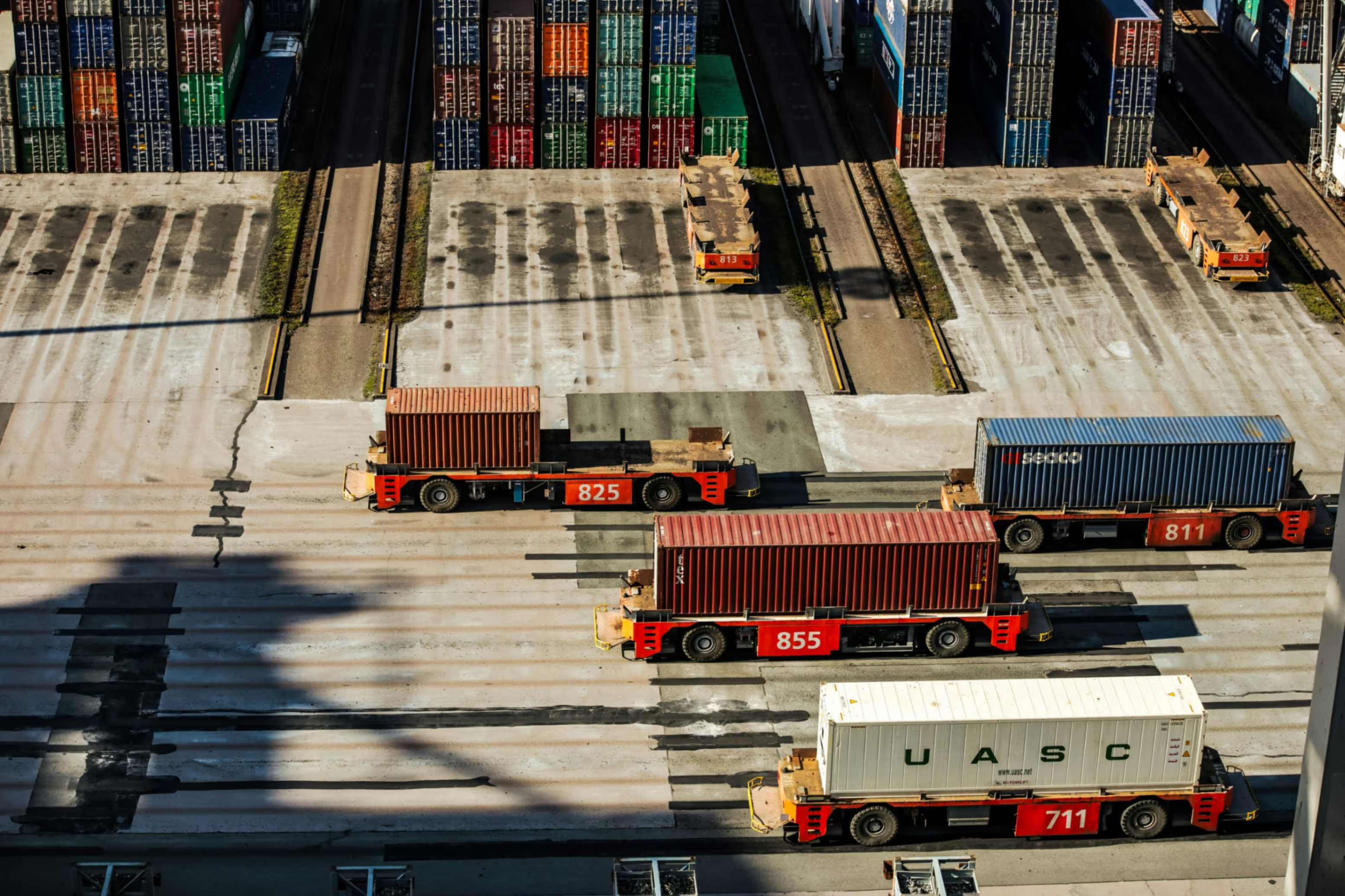
Moving a product is no longer just about trucks, ships, and warehouses, it’s also about precision, visibility, and customer experience.
Logistics and distribution determine how efficiently products reach their destination. This includes transport optimization, ensuring goods move through borders and customs smoothly, free from manipulation or documentation delays. Tamper-proof documentation and traceability reduce the risk of products being held, inspected, or rejected during transports across borders.
Warehousing and inventory management are equally critical. Companies must balance storage capacity with demand, ensuring products are available without incurring unnecessary carrying costs.
The final challenge is last-mile delivery, the journey from distribution center to customer doorstep. Customer expectations have never been higher: when someone orders a package, they expect it to move seamlessly from a postal service such as USPS to their doorstep within the expected time, at their convenience. It’s no surprise that last-mile delivery is now a defining factor in customer satisfaction and brand loyalty.
Returns and Reverse Logistics
The end of a product’s life cycle is just the beginning of its return journey. Reverse logistics covers everything that happens after a customer sends a product back: processing returns, quality checks, refurbishment, recycling, and re-entering materials into the circular economy. Effective reverse logistics is crucial for reducing waste, recovering value, and supporting environmental commitments.
It also plays a major role in compliance. Returned goods often pass through customs and recycling facilities that require proper documentation, proof of origin, and accurate reporting. Ensuring this information is correct and available prevents delays, fines, or regulatory issues.
After overviewing pillars of planning, procurement, production, logistics, and returns, one pattern becomes clear: modern supply chains depend on fast, accurate and secure information flows at every step. Whether it’s forecasting demand, onboarding a supplier, validating a test report, or passing customs checks, the ability to access complete, verifiable and manipulation-free documentation determines how efficiently a supply chain operates.
This is where digital compliance ecosystems like Kevla TrustDocS seamlessly support the process. By providing instant access to certifications, automated alerts for expiring documents, and secure API connections across the supply chain, Kevla strengthens each pillar of Supply Chain Management, helping companies transition from manual coordination to intelligent, secure and connected supply chains.
The Role of Technology in Modern Supply Chain Management
For decades, supply chains were coordinated mainly through physical flows: materials moved from suppliers to factories, products were shipped to warehouses, and goods were delivered to customers.
Information often followed later, by phone calls, emails, or paper documents. If something went wrong, companies mostly found out after the fact.
Today, this model is no longer working.
In parallel with physical movements, modern supply chains are coordinated through digital systems that manage planning data, production status, transport events, and compliance documentation.
When a shipment crosses a border, customs documents must already be available. When a batch of raw material arrives at a factory, quality certificates must already be validated. When a supplier is selected, ESG and compliance data must already be verified.
Technology has therefore become the backbone of supply chain coordination, not because it replaces physical logistics, but because it facilitates it. Hence, it ensures that decisions, approvals, and compliance checks happen fast enough to keep goods moving.
What matters is no longer just whether companies use supply chain management software, but:
- which software systems are used
- how they exchange data
- whether critical documents can be trusted, traced, and verified across company boundaries
This is where modern supply chain technology shifts from operational support to strategic infrastructure.
ERP, SCM, and MES Systems: From Silos to Connected Ecosystems
Most supply chains rely on several core systems, each responsible for a specific part of daily operations.
An ERP system (Enterprise Resource Planning) is the central system a company uses to manage business transactions and resources. It typically handles purchasing, supplier orders, inventory levels, contracts, invoices, and financial accounting. When procurement orders raw materials, when inventory is booked, or when a supplier invoice is paid, these actions usually happen in the ERP system. For many companies, ERP systems form the administrative backbone of the supply chain.
A SCM system (Supply Chain Management system) builds on this foundation by focusing on planning and coordination. It supports demand forecasting, production planning, transport scheduling, and inventory optimization across multiple locations. While ERP systems record what has been ordered or delivered, SCM systems help decide what should happen next across the supply chain.
A MES system (Manufacturing Execution System) operates much closer to the factory floor. It manages how production actually takes place in real time. MES systems control production orders, track machine activity, record quality checks, and ensure traceability of batches and materials. For example, even if an ERP system plans production, the MES system decides when a machine starts, whether quality tests are passed, and whether a batch can be released.
The challenge is that critical compliance and quality documents often sit in between these systems. A production batch may not be released in the MES until a test certificate is approved. A supplier invoice in the ERP may not be finalized until compliance documents are verified. When these documents are exchanged manually through emails or shared folders, delays and errors are inevitable.
This is why modern supply chains increasingly rely on dedicated document exchange and compliance platforms. Platforms like Kevla TrustDocS are not designed to replace ERP, SCM, or MES systems, nor to add another silo that teams must maintain. Instead, Kevla operates as an enabling layer that connects existing systems and removes friction between them.
Kevla TrustDocS ensures that certificates, audit reports, and compliance documents are securely shared, verified, and continuously available to ERP, SCM, and MES systems exactly when they are needed. Thus, operational systems do not have to wait for files or manual confirmation. They simply consume a verified compliance status. As a result, documentation no longer interrupts workflows but becomes an integrated part that accelerates the process significantly.
By integrating Kevla TrustDocS into existing ERP, SCM, and MES environments, companies move from disconnected systems to a connected ecosystem where compliance information flows automatically and reliably.

Standard Solutions vs. Custom Complexity
Many companies face a familiar dilemma. Off-the-shelf systems rarely fit perfectly, while custom-built solutions quickly become expensive, rigid, and difficult to maintain. Tools that are developed to solve a single internal problem often create new silos elsewhere in the organization over time.
In supply chains, this trade-off is especially risky. The environment is constantly changing:
- Regulatory requirements evolve
- Supplier networks expand or shift
- New reporting and documentation obligations emerge
Custom solutions struggle to adapt to this pace of change. As a result, modern SCM increasingly relies on specialized platforms that address specific challenges across organizations rather than within a single company.
Instead of each business building and maintaining its own compliance workflows, platforms like Kevla TrustDocS provide ready-made, continuously updated infrastructure for supplier documentation, verification, and audit readiness. This reduces maintenance overhead rather than increasing it and allows companies to focus on their core operations while relying on systems designed to evolve alongside regulatory and industry developments.
Artificial Intelligence and Machine Learning
Artificial intelligence has moved beyond experimentation in supply chains and now plays a practical role in daily operations. Its value lies not in automation alone, but in improving foresight and decision-making. Machine learning models analyze large volumes of data, including:
- Historical sales figures and seasonal patterns
- Supplier behavior and delivery performance
- Documentation updates and compliance signals
In procurement, AI can flag suppliers whose patterns indicate rising risk. In compliance, algorithms can detect anomalies such as missing certificates or unusual update behavior across supplier networks.
These capabilities depend on access to high-quality, structured data. APIs are critical here, as they allow AI systems to consume current information from multiple sources automatically. By providing standardized and verified compliance data through APIs, platforms like Kevla TrustDocS ensure that AI systems work with reliable inputs rather than fragmented documents and manual records. The result is faster, more confident decisions based on consistent data.
Cybersecurity as a Supply Chain Responsibility
As supply chains become more digital, they also become more exposed. Cybersecurity is no longer limited to internal IT systems. Every connected supplier, platform, and document exchange point increases the overall attack surface.
A single weak link, such as an insecure supplier portal or an unprotected file transfer, can introduce risks that affect the entire network. These weak links are often considered “soft targets” and are therefore a frequent focus of cybercriminals, as they are typically easier to infiltrate with malware than well-secured core systems. Once compromised, they can act as multipliers, allowing attackers to move laterally across connected partners and systems. Regulations increasingly reflect this reality by requiring companies to demonstrate secure data handling across their supply chains, not just within their own systems.
Secure document exchange therefore becomes a core element of modern SCM. This includes:
- Encryption of sensitive data
- Controlled access based on roles and permissions
- Audit trails that record every interaction
Kevla TrustDocS is designed with these requirements in mind. By ensuring secure sharing, controlled access, and full traceability, cybersecurity shifts from an implicit risk to an actively managed capability.
Supplier Portals and Digital Tenders
Supplier portals have become a central interface between companies and their partners. They are used for tenders, onboarding, communication, and document submission. When designed well, they reduce friction and create clarity. When designed poorly, they become bottlenecks.
A common problem is redundancy. Suppliers are asked to upload the same certificates repeatedly for different customers or tenders. Buyers, in turn, spend time verifying documents that may already exist verified elsewhere.
Lately, modern SCM shifts away from one-off uploads toward reusable, verifiable trust documents. Kevla supports this shift by allowing suppliers to maintain a single, up-to-date set of tamper-proof certificates that can be securely shared across multiple business relationships. This reduces administrative burden on both sides and accelerates procurement and tender processes without compromising compliance.
IoT and Real-Time Tracking
Internet of Things (IoT) technologies, which connect physical devices and sensors to digital systems, add a physical dimension to digital supply chains. Sensors track location, temperature, humidity, and handling conditions in real time. This is especially critical for sensitive goods such as pharmaceuticals, food, or high-value components.
However, real-time tracking data only becomes truly valuable when it is connected to contextual information. A temperature deviation during transport matters far more when it can be linked directly to quality requirements, test reports, and compliance thresholds.
By connecting tracking data with verified documentation, supply chains gain a deeper level of accountability. Events are no longer isolated data points. They become part of a documented, auditable process that supports both operational decisions and regulatory reporting.
Cloud-Based Collaboration and API Ecosystems
Cloud platforms have transformed supply chain collaboration. Instead of exchanging static files via email, partners now operate within shared digital environments that update continuously.
API ecosystems extend this model further by enabling automated data exchange between systems. In practice, this means:
- Certificates can be validated automatically
- Expiry dates can trigger alerts proactively
- Compliance status can be checked instantly across platforms
Kevla TrustDocS fits naturally into this ecosystem by acting as a central trust layer within cloud-based supply chain architectures. It connects suppliers, buyers, auditors, and systems through secure APIs while preserving data integrity and traceability.
The Shift Toward Data-Driven and Automated Compliance
One of the most significant changes in SCM is the transition from manual, episodic compliance to continuous, data-driven processes. Regulations increasingly require companies to demonstrate due diligence on an ongoing basis, not just during audits.
This changes how compliance is managed. Companies now need:
- Continuous visibility into supplier status
- Early warnings instead of reactive document collection
- Embedded controls rather than manual checks
Technology enables this shift. Automated validation, real-time alerts, and structured documentation transform compliance from a reactive burden into an integrated part of supply chain operations. Kevla TrustDocS supports this approach by embedding compliance directly into workflows, ensuring that trust is continuously verified rather than assumed.

6. Sustainability and Compliance in Supply Chains
Sustainability and compliance have moved from being peripheral concerns to becoming central requirements for how supply chains operate. Companies are no longer judged only on what they produce, but also on how responsibly they source materials, treat workers, protect the environment, and document these efforts. What makes this shift particularly challenging is that responsibility does not stop at company boundaries. It extends across suppliers, sub-suppliers, and partners, often spanning multiple countries and legal systems.
This section explains what sustainability and compliance mean in practice, why documentation and traceability matter so much, and how EU regulations are reshaping supply chain management.
ESG and Sustainability Goals
For many organizations, sustainability is structured around ESG, which stands for Environmental, Social, and Governance. ESG provides a framework for assessing how responsibly a company operates, both internally and across its supply chain.
In practice, ESG raises concrete operational questions, such as:
- Where do raw materials originate?
- Are workers protected from exploitation?
- Are emissions measured and actively reduced?
- Are decisions documented and accountable?
Environmental goals often focus on reducing carbon emissions in transport or sourcing materials with a lower environmental footprint. Social goals address labor standards, health and safety, and human rights at supplier sites. Governance covers how risks are identified, decisions are made, and transparency is ensured.
The challenge in supply chains is that most ESG-relevant data sits outside the company. It depends on suppliers and their own suppliers in turn, providing accurate information, certificates, and audit results. Without reliable documentation, ESG remains an intention rather than a verifiable practice.
EU Regulatory Frameworks: Why Supply Chains Are Under Pressure
To turn sustainability goals into enforceable standards, the European Union has introduced a growing set of regulations that directly affect supply chains. These laws are designed to ensure that companies identify risks, take preventive action, and prove compliance through documentation.
Rather than focusing only on financial performance, these frameworks require companies to understand and manage the impact of their entire value chain. While each regulation has a different scope, they share a common expectation: companies must know their suppliers, assess and mitigate risks, as well as document what they are doing.
Below is a closer look at the most relevant regulations.
LkSG: German Supply Chain Due Diligence Act
The LkSG (Lieferkettensorgfaltspflichtengesetz) is a German law that applies to large companies (at least 1,000 employees) operating in Germany. It requires them to identify, assess, and mitigate human rights and environmental risks in their supply chains.
In practice, this means companies must examine their suppliers for risks such as child labor, unsafe working conditions, or environmental harm. They are expected to implement preventive measures, establish complaint mechanisms, and document all relevant actions.
For example, a manufacturer sourcing components from abroad must be able to show that it has assessed supplier risks, requested relevant certifications, and taken action when risks were identified. If authorities request evidence, verbal assurances are not enough. Companies must provide documented proof.
CSDDD: Corporate Sustainability Due Diligence Directive
The CSDDD is an EU-wide directive that expands the idea behind the LkSG to a broader set of companies across Europe. Once implemented into national law, it will require large companies and certain non-EU companies operating in the EU to conduct sustainability due diligence across their entire supply chain.
Unlike national laws, the CSDDD aims to create a harmonized approach across member states. It covers human rights, environmental protection, and climate-related obligations. Companies must identify risks, prevent or mitigate harm, and monitor the effectiveness of their measures.
A concrete example would be a multinational company with suppliers in multiple EU and non-EU countries. Under the CSDDD, it must demonstrate that due diligence is not limited to direct suppliers but extends to relevant parts of the upstream supply chain.
CSRD: Corporate Sustainability Reporting Directive
While LkSG and CSDDD focus on actions, the CSRD focuses on reporting. It requires companies to publicly disclose detailed sustainability information, including risks, targets, and progress. CSRD significantly expands the scope and depth of sustainability reporting. Companies must report using standardized criteria and ensure that the information is accurate and auditable.
In supply chains, this means companies need structured, reliable data from suppliers. Emissions data, certifications, and audit outcomes must be collected in a way that supports consistent reporting. Manual data collection or scattered documents quickly become a bottleneck when reporting deadlines approach.
EUDR: EU Deforestation Regulation
The EUDR targets products linked to deforestation, such as coffee, cocoa, soy, palm oil, and wood. Companies placing these products on the EU market must prove that they are not associated with deforestation or forest degradation.
This requires traceability down to the origin of raw materials. Companies must collect geolocation data, supplier declarations, and supporting documentation.
For example, an importer of cocoa must be able to show where the cocoa was grown and demonstrate that the land was not deforested after a specified date. Without traceable documentation, products may be denied market access.
ESRS: European Sustainability Reporting Standards
The ESRS define how sustainability information must be reported under the CSRD. They provide detailed requirements on what companies need to disclose and how.
For supply chains, ESRS reinforce the need for consistent documentation. Companies must explain how they identify risks, what measures they take, and how they monitor outcomes. This requires structured inputs from suppliers, not ad hoc explanations.
EU AI Act: Sustainability and Governance Beyond the Environment
While often associated with technology, the EU AI Act also affects supply chains, particularly where automated decision-making and AI systems are used. It introduces governance requirements for transparency, risk management, and accountability.
For example, if AI is used to assess supplier risks or make procurement decisions, companies must understand how these systems work and ensure they are compliant with regulatory expectations. This links sustainability, governance, and digital responsibility.
These topics are discussed in more depth in Johannes’ interview, which explores how AI regulation intersects with trust and compliance in complex ecosystems.
Why Documentation, Verification, and Traceability Matter
Across all these regulations, one theme is constant: compliance is not based on intention, but on evidence.
Companies must be able to show:
- which suppliers were assessed
- which documents were reviewed
- which risks were identified
- which actions were taken
Documentation, verification, and traceability turn compliance into something measurable and defensible. Without them, companies struggle during audits, reporting cycles, or regulatory inquiries.
Supplier Audits, Due Diligence, and Third-Party Verification
To meet regulatory requirements, many companies rely on supplier audits and third-party verification. Independent audits, certifications, and test reports provide credibility and reduce risk.
However, audits only create value if their results are properly stored, tracked, and shared. An audit report that sits in an email inbox is effectively invisible to the rest of the organization. A certificate that expires unnoticed can invalidate months of due diligence.
This is why companies increasingly treat audit data as part of their operational infrastructure and valuable control instruments rather than as static documents.
How Kevla Fits into Sustainability and Compliance
Managing sustainability and compliance across supply chains is fundamentally a documentation and coordination challenge. Kevla simplifies this by providing a central platform, Kevla TrustDocS, where compliance documents, certificates, and audit evidence can be securely stored, shared, and verified.
Instead of collecting documents repeatedly for different regulations or audits, companies can rely on structured, up-to-date records.
Expiration alerts, controlled access, and traceable updates support audit readiness and reduce manual effort, exchanging information with others, tamper-proof.
In this way, Kevla does not replace sustainability strategies or compliance processes. It makes them easily operational by ensuring that the evidence behind them is always available, verifiable, and ready when it matters most.

7. Risk Management in Supply Chains
Risk management has become one of the most decisive capabilities in modern supply chains. Disruptions no longer come as rare exceptions. They are a constant presence, triggered by supplier failures, regulatory changes, geopolitical tensions, or data breaches. Companies that manage supply chain risk effectively are not those that eliminate such risk entirely, but those that recognize it early and respond in time.
Understanding Risk Identification and Assessment
Risk management starts with a deceptively simple question: where can things go wrong?
Risk identification and assessment frameworks help companies systematically map vulnerabilities across their supply chains. This requires looking beyond direct suppliers and understanding how materials, information, and responsibilities flow across multiple tiers.
In practice, companies evaluate risks by examining factors such as:
- supplier reliability and past performance
- geographic exposure and political stability
- regulatory requirements and compliance maturity
- dependencies on single suppliers or regions
Not all risks are equal. A supplier operating reliably in a volatile regulatory environment poses a different threat than one with strong governance but limited production capacity. The purpose of risk assessment is therefore not to predict every disruption, but to identify which risks are most likely and weigh which would cause the greatest impact if they occur.
Scenario Planning and Mitigation Strategies
Identifying risks is only useful if companies are prepared to act when those risks actualize. This is where scenario planning becomes critical.
Scenario planning focuses on practical “what if” questions. What if a supplier cannot deliver due to a strike? What if new documentation is required with little notice? What if a key certificate expires during peak production?
Effective risk mitigation strategies often combine several measures, including:
- supplier diversification to reduce dependency
- buffer inventories or alternative sourcing options
- predefined escalation and response processes
- real-time monitoring to detect early warning signals
For example, a system that flags an upcoming certificate expiration allows procurement and production teams to intervene before materials are blocked or shipments delayed. The goal is not to react faster after disruption, but to prevent disruption altogether.
The Many Faces of Supply Chain Risk
Supply chain risk is not a single category. It takes many forms, each affecting companies in different ways.
- Operational risks include production breakdowns, transport delays, or supplier capacity constraints, etc.Financial risks
- Financial risks may arise from supplier insolvency, including currency fluctuations, or sudden cost increases.Compliance and legal risks
- Compliance and legal risks emerge when regulations are not met or documentation is incomplete.Geopolitical risks
- Geopolitical risks involve trade restrictions, sanctions, or political instability in supplier regions and so on.Cybersecurity risks
- Cybersecurity risks stem from interconnected digital systems and third-party access points and many other forms.Environmental risks
- Environmental risks include but are not limited to extreme weather conditions or resource scarcity.Quality risks
- Quality risks appear when materials fail to meet specifications, testing requirements, etc.
What connects these risks is their tendency to overlap. A geopolitical event can trigger regulatory changes. A cyber incident can interrupt operations in many companies at once due to connected supply chains. A missing quality document can escalate into a legal issue. Effective risk management therefore requires a holistic view rather than isolated controls.
Real-Time Risk Monitoring Through Digital Tools
Traditional risk management in supply chains is largely periodic and retrospective. Risks are reviewed at fixed intervals, documented in spreadsheets, and discussed once problems have already surfaced. In fast-moving and highly regulated supply chains, this creates blind spots between reviews, where risks can escalate unnoticed.
Real-time risk management follows a different logic. Instead of asking what went wrong, it focuses on what is changing right now and whether those changes are increasing the likelihood of disruption. Digital tools enable this shift by continuously monitoring signals that indicate emerging risk.
These signals typically fall into several categories:
- Operational indicators, such as delivery performance, inventory levels, or supplier capacity
- Regulatory indicators, including new requirements or changes in applicable standards
- Documentation indicators, such as missing, outdated, or soon-to-expire certificates
Among these, documentation status is often underestimated, even though it directly determines whether materials can be used, shipments can move, or production can continue.
Certificates, licenses, and approvals are not static assets. They expire, change scope, or become invalid when regulations are updated. In a traditional setup, these issues are often discovered too late, for example when production is blocked, a shipment is delayed, or an audit is already underway.
Digital tools change this dynamic by turning documents into active risk signals. Instead of checking validity manually, systems monitor expiration dates continuously and trigger alerts well in advance. For example, if a material approval required for production is due to expire in four weeks, procurement and compliance teams can intervene early by requesting updates or adjusting sourcing plans. What would have been an unexpected disruption becomes a planned action.
This illustrates the core difference between traditional and real-time risk management:
- Periodic risk management reacts after a problem occurs
- Real-time risk management detects early warning signs and enables intervention before impact
As a result, risk management shifts from firefighting to prevention and becomes part of everyday operations rather than an occasional exercise.
This is where digital platforms like Kevla TrustDocS add tangible value. By continuously tracking the validity of compliance documents, alerting teams to upcoming expirations, and making verified information available across systems in real time, The smart platform supports risk management as an ongoing operational capability.
Instead of relying on manual checks and delayed reporting, companies gain supply chain visibility that helps protect production flow, reduce disruptions, and maintain regulatory readiness.
8. The Human and Organizational Side of Supply Chain Management
Supply chains are often discussed in terms of systems, regulations, and processes. But at their core, they are designed, operated, and improved by people. Even the most advanced technology cannot compensate for unclear responsibilities, resistant cultures, or poor coordination between teams. Modern Supply Chain Management therefore depends as much on organizational mindset and collaboration as it does on digital tools.

Leadership and Culture: Setting the Direction
Every supply chain transformation starts at the top. Leadership determines whether risk management, transparency, and innovation are treated as strategic priorities or as administrative burdens.
A culture that is open to change encourages teams to question outdated processes and adopt new ways of working. This is particularly important in supply chains, where legacy tools and habits are deeply entrenched. Leaders who recognize risk mitigation as a strategic objective understand that digital tools are not introduced for their own sake. They are introduced to reduce dependency on manual processes, minimize blind spots, and create resilience.
For example, a leadership team that supports digital document management makes it easier for procurement and compliance teams to move away from spreadsheets and email-based workflows. Instead of reacting to problems after they occur, teams gain tools that help prevent disruptions in advance.
Cross-Departmental Collaboration
Supply chain management rarely belongs to a single department. It typically involves several functions, each with distinct responsibilities:
- Procurement selects and manages suppliers
- Compliance ensures regulatory alignment
- IT maintains and integrates systems
- Sustainability teams collect and report ESG data
When these functions operate in isolation, gaps quickly emerge. A common scenario illustrates this: Procurement onboards a new supplier to meet production demand. Compliance later identifies missing certificates. IT is asked to integrate a new tool under time pressure. Sustainability teams request data suppliers were never asked to provide. Each issue is manageable on its own, but together they slow operations and increase risk.
Effective SCM requires collaboration to be built into everyday workflows. Shared platforms and common data structures allow teams to work from the same information base. When supplier documentation is collected once and made accessible across departments, friction decreases and accountability becomes clearer.
Digital tools support this collaboration by creating a single point of reference for supplier data and compliance status. Instead of manually passing information between teams, departments can focus on decisions rather than coordination.
Skills and Training for Digital SCM Professionals
As supply chains become more digital and more regulated, the role of supply chain professionals continues to evolve. Operational expertise alone is no longer sufficient. Many roles now require familiarity with data management, regulatory frameworks, and digital systems.
In practice, this often means:
- Quality managers must demonstrate training in relevant standards
- Compliance officers need up-to-date regulatory knowledge
- Certain tasks must be performed by certified personnel
This adds a new layer of responsibility. Companies must not only ensure that employees are trained but also document those qualifications and keep certifications current. When personnel certifications expire or cannot be verified, audits may fail or critical processes may be interrupted.
Digital systems help manage this complexity by tracking qualifications alongside supplier and process documentation. By maintaining verifiable records of both organizational and individual certifications, companies ensure that skills development strengthens compliance instead of becoming another source of risk.
9. Measuring Supply Chain Management Performance
You cannot improve what you cannot see. In supply chain management, performance only becomes actionable when it is measured consistently and interpreted correctly. Metrics turn complex operations into understandable signals and help organizations decide where to invest, where to intervene, and where risks are quietly building up.
From Activity to Insight: What KPIs Really Measure
Key performance indicators, often called KPIs, translate day-to-day supply chain activity into measurable outcomes. They help answer practical questions such as: How fast are we delivering? How reliable are our suppliers? How much capital is tied up in inventory? Are we meeting sustainability and compliance expectations?
Some KPIs focus on speed and reliability, others on efficiency, risk, or sustainability. In modern supply chains, the most commonly used KPIs include:
- Lead time: the time it takes for goods or materials to move through the supply chain, for example from placing an order with a supplier to receiving the shipment. Long or volatile lead times often indicate bottlenecks, supplier dependency, or documentation delays.
- OTIF (on-time-in-full): measures whether deliveries arrive on the agreed date and with the correct quantity. A low OTIF score is rarely just a logistics issue. It often points to planning gaps, missing approvals, or unreliable suppliers.
- Inventory turnover: shows how often inventory is sold or used within a defined period. A low turnover can signal overstocking and tied-up capital, while an extremely high turnover may indicate vulnerability to supply disruptions. The objective is balance, not maximization.
- Carbon footprint: tracks emissions generated by production, transport, and sourcing activities. Unlike traditional cost KPIs, carbon metrics increasingly depend on data provided by suppliers rather than internal estimates.
- Supplier compliance rate: measures how many suppliers have submitted valid, up-to-date documents such as certificates, declarations, or audit reports. This KPI has become central under regulations such as LkSG, CSDDD, and CSRD.
Supplier compliance rate is a good example of how operational performance and regulatory readiness overlap. A high compliance rate indicates that documentation is managed proactively and risks are controlled early. A low rate often leads to last-minute document requests, delayed approvals, blocked shipments, and stressful audits.
What connects all these KPIs is their dependence on accurate and timely information. When legal or compliance documents are exchanged manually or stored in disconnected systems, performance data becomes unreliable. Secure and structured document exchange supports better measurement by ensuring that compliance status is visible and verifiable rather than assumed.
Making Performance Visible: Dashboards and Digital Monitoring
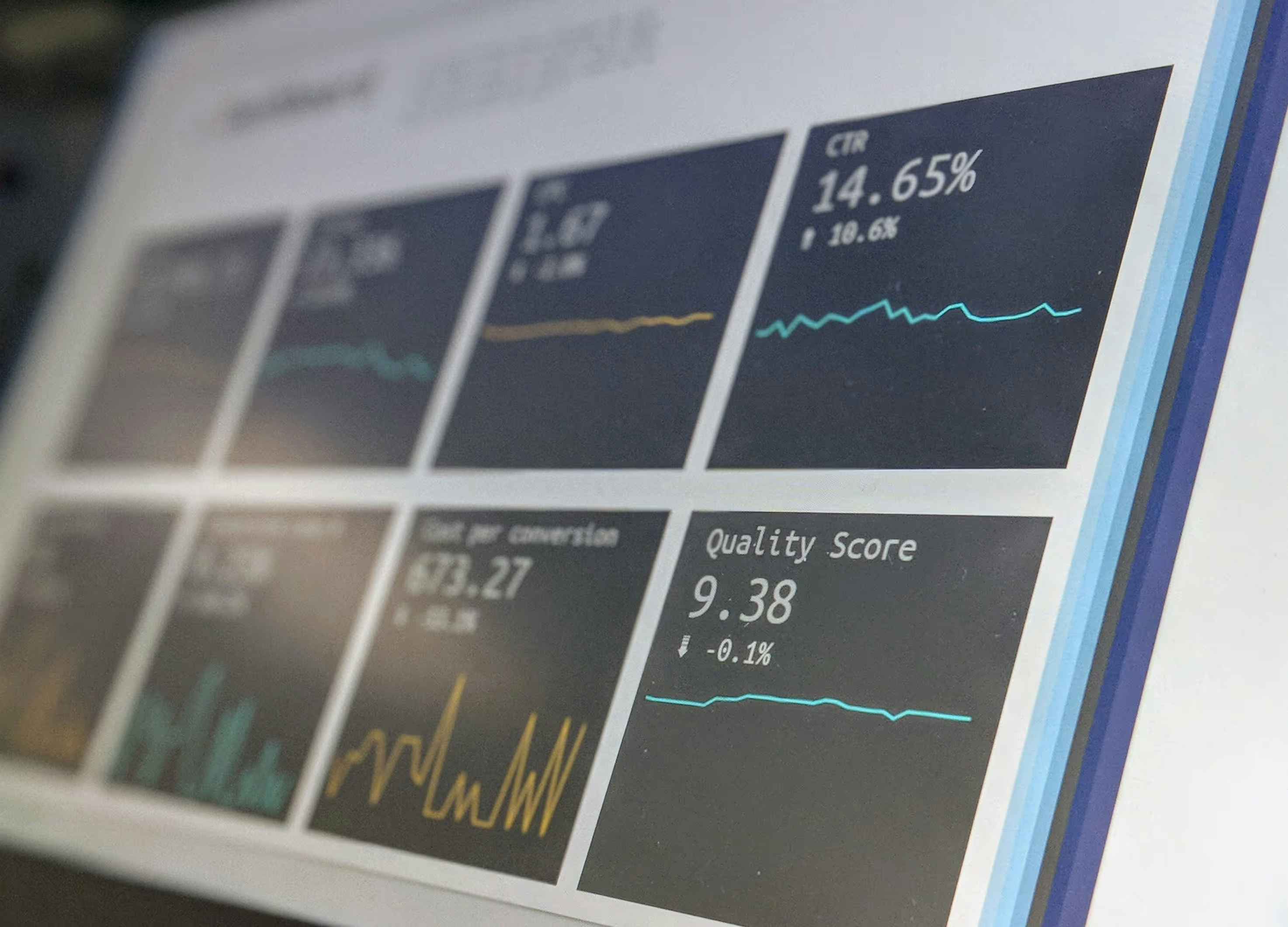
Raw numbers alone do not improve supply chains. What matters is how information is structured, visualized, and used in daily decision-making. Dashboards and digital monitoring tools translate KPIs into insights that teams can act on. A dashboard typically brings multiple indicators together in one place. For a supply chain manager, this might include:
- lead times by supplier
- OTIF performance by region
- inventory levels by warehouse
- compliance status across the supplier base
Seeing these metrics side by side allows teams to identify patterns and trends early, rather than reacting once issues escalate.
Digital monitoring also enables proactive intervention. If a dashboard shows compliance rates declining due to certificates' nearing expiration, procurement and compliance teams can step in before production is affected. If carbon footprint indicators rise for a specific transport route, logistics teams can investigate alternatives before reporting deadlines are missed.
Beyond operational control, dashboards support consistent reporting. Many regulations and internal audits require performance data to be produced regularly and in a repeatable format. When KPIs are generated automatically from connected systems, reporting shifts from a periodic scramble for data to a continuous process embedded in daily operations.
Platforms like Kevla TrustDocS support this approach by ensuring that compliance-related KPIs are grounded in verified documentation rather than assumptions. When certificates, audit reports, and legal documents are exchanged securely and tracked centrally, supplier compliance can be monitored in real time. Performance management then extends beyond cost and speed to include regulatory readiness, risk prevention, and trust.
Measuring supply chain performance is not about collecting more data. It is about collecting the right data and making it usable to trigger actions and improve performance. When KPIs are clearly defined, continuously monitored, and linked to reliable documentation, they become a practical tool for improving resilience, efficiency, and transparency across the supply chain.
10. The Future of Supply Chain Management
Supply chains are entering a new phase of maturity. What was once optimized mainly for cost and speed is now being redesigned for resilience, accountability, and long-term stability. The future of Supply Chain Management will be shaped by how well companies combine advanced technology with trustworthy data and cross-company collaboration.
From Prediction to Anticipation: AI-Driven Planning
The next generation of supply chain planning will be defined by anticipation rather than reaction. Artificial intelligence is increasingly used to analyze large volumes of data such as historical sales, weather patterns, transport disruptions, and supplier behavior to forecast demand and identify risks earlier.
For example, AI-driven planning tools can detect subtle changes in order patterns that indicate a future spike in demand. They can also flag suppliers whose delivery performance or documentation behavior suggests growing risk. These insights allow planners to adjust production schedules, sourcing strategies, or inventory levels before problems actualize.
However, AI systems are only as reliable as the data they consume. When compliance documents, certificates, or supplier information are incomplete or outdated, predictive models lose accuracy. This is why structured, verified data is becoming a critical input for intelligent planning systems.
Designing Circular Supply Chains
Future supply chains will not end when a product reaches the customer. Circular supply chains aim to keep materials in use for as long as possible through reuse, repair, recycling, and recovery.
This shift requires a deeper understanding of product composition and lifecycle. For example, a company that wants to recycle electronic components must know which materials are used, where they came from, and whether they meet environmental and safety standards. Without this information, circular processes become inefficient or legally risky.
Circularity also changes supplier relationships. Partners are no longer only evaluated on cost and quality, but also on their ability to support material recovery and sustainability goals. Documentation and traceability therefore become central to making circular models operational rather than theoretical.
Compliance Automation as a Standard Capability
As regulatory requirements continue to expand, compliance can no longer be treated as a periodic task. The future of supply chain management lies in compliance automation, where checks, validations, and alerts happen continuously in the background.
Instead of collecting documents once a year for an audit, companies will rely on systems that monitor compliance status in real time. When a certificate expires, an alert is triggered. When a new regulation applies to a supplier category, relevant documentation requirements are updated automatically.
This approach reduces manual effort and lowers the risk of last-minute disruptions. It also shifts compliance from a defensive activity to a proactive capability that supports operational continuity.
Toward Interconnected and Resilient Supply Networks
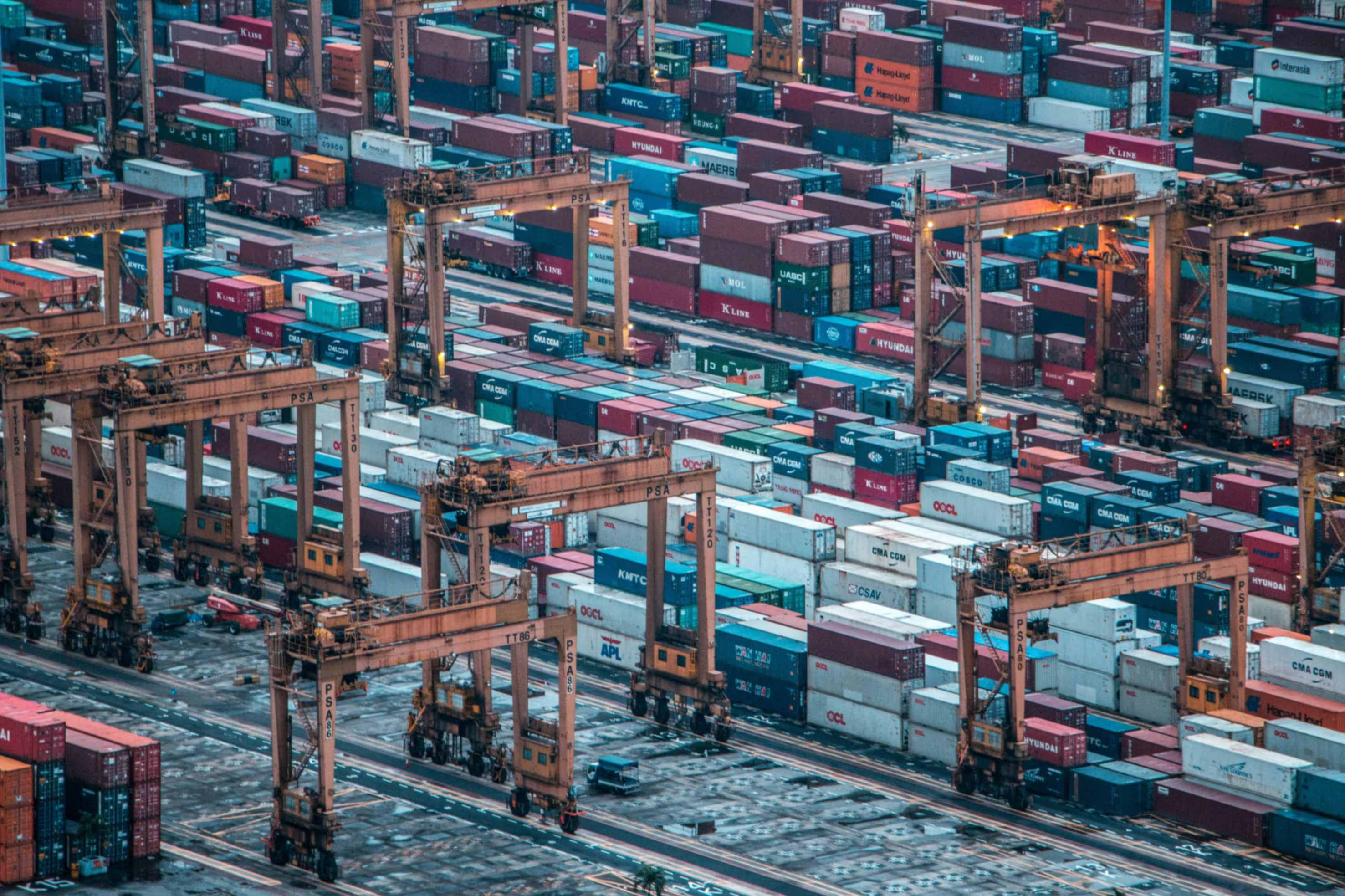
Supply chains are becoming less linear and more network-based, meaning they no longer follow a simple, one-directional flow from supplier to manufacturer to customer. Instead, companies operate within interconnected ecosystems where multiple suppliers, logistics providers, auditors, and technology platforms exchange information and responsibilities simultaneously. In these networks, resilience depends on transparency.
Interconnected supply networks therefore require common standards for data exchange and verification. Without shared rules and trusted platforms, collaboration remains slow and error-prone.
Digital Trust as the New Currency of Supply Chains
As supply chains become more interconnected and regulated, trust shifts from personal relationships to verifiable data. Digital trust ecosystems make it possible to rely on information without repeated manual checks.
In practice, this means certificates issued by recognized authorities, audit reports from independent bodies, and compliance documents that can be shared securely and traced over time. Verified data becomes a form of currency that allows companies to move faster, reduce risk, and demonstrate responsibility.
This is where platforms like Kevla play a defining role. By enabling secure document exchange, verified compliance data, and controlled access across supply networks, Kevla helps companies operate in an environment where trust is not assumed but continuously proven.
In the future of Supply Chain Management, the companies that succeed will not be those with the most data, but those with the most trusted data. Digital trust and verified compliance information are becoming the foundation on which resilient, transparent, and globally connected supply chains are built.
11. Conclusion
Supply Chain Management has changed fundamentally. What once focused primarily on moving goods efficiently now spans risk management, sustainability, regulatory compliance, and digital coordination across global networks. Throughout this guide, one insight has remained consistent: Modern supply chains do not succeed by optimizing isolated functions, but by connecting planning, operations, people, and data into a cohesive system.
Effective supply chains anticipate demand rather than react to it. They evaluate suppliers not only on price and delivery reliability, but also on quality performance, ESG criteria, and compliance readiness. They rely on real-time visibility to identify risks early, respond to disruptions, and measure performance using meaningful KPIs. Increasingly, they are also shaped by regulatory frameworks that demand evidence, traceability, and transparency rather than informal assurances.
What connects all of these dimensions is the availability of reliable, shared information. Compliance obligations depend on complete, current, and auditable documentation. Risk management depends on knowing what has changed and when. Technology only creates value when systems can exchange trusted information automatically, without manual effort, duplication, or delays. When these elements remain disconnected, supply chains are brittle. When they are aligned, supply chains become resilient.
This is where Kevla evolves beyond a single platform and becomes a digital ecosystem for trust and compliance. Kevla does not replace ERP, SCM, or MES systems, nor does it add another layer of administrative work. Instead, it provides the infrastructure that connects suppliers, buyers, auditors, and operational systems through shared rules, verified documents, and continuous validation. Certificates, audit reports, and compliance evidence are no longer static files passed between inboxes. They become live, reusable trust assets that flow automatically across the supply chain and into the systems where decisions are made.
By combining secure document exchange, real-time verification, API-based integration, and audit-ready traceability, Kevla helps companies turn regulatory complexity into operational stability. Compliance stops being a periodic exercise and becomes an integrated capability that supports procurement, production, sustainability reporting, and risk management at the same time.
Does information flow through your supply chain as smoothly as materials?
Learn how Kevla turns documentation into a reliable part of supply chain operations.